


In late July and early August 2026, the Florida Department of Health confirmed something that hadn't happened in Tampa Bay in a while: dengue fever transmitted locally, in Hillsborough and Pinellas counties, in people who had not traveled anywhere.
If you've seen the headlines and weren't sure what to make of them, this is a plain explanation of what "locally acquired" means, which mosquito is responsible, and which of the many pieces of advice floating around actually changes anything in a Florida yard.
What "locally acquired" actually means
Florida records dengue cases every year, and most are travel-associated - someone gets infected abroad and is diagnosed after returning home. Those cases don't tell you much about local risk.
A locally acquired case is different. It means the person was infected here, by a mosquito here. For that to happen, a local mosquito had to bite an infected person, survive long enough for the virus to develop, and then bite someone else. It confirms the transmission chain exists in the area, which is why county mosquito control responds to these cases with targeted spraying, larviciding, and door-to-door inspections rather than treating them as isolated events.
As of mid-August 2026, Hillsborough and Pinellas had reported roughly ten locally acquired cases between them, with response activity concentrated in East Tampa, the Picnic Island area of South Tampa, and Palm Harbor.
Some perspective is warranted: a cluster of local cases is not an epidemic, and the response from both counties has been fast and public. But it does mean the assumptions most of us carry about mosquitoes in Florida are worth revisiting, because the mosquito involved does not behave the way people expect.
The mosquito behind it is not the one you're used to
Dengue is carried by Aedes aegypti, the yellow fever mosquito. It's a different animal from the salt marsh mosquitoes that most Floridians think of, and nearly every piece of received wisdom about avoiding mosquitoes is wrong for this species.
It bites during the day. Aedes aegypti feeds primarily in daylight, with peaks in the morning and again in the late afternoon. The common habit of avoiding the yard at dusk and considering yourself covered is protection during the hours this particular mosquito is least active.
It breeds in containers, not swamps. It doesn't need a pond, a ditch, or standing marsh. It needs a small volume of still water in an artificial container: a saucer under a potted plant, a clogged gutter, a sagging tarp or pool cover, a pet bowl, a forgotten toy, a bottle cap. Hillsborough County officials made this exact point during the response - a bottle cap of standing water is enough for a viable breeding site.
It doesn't travel. This is a weak flyer that typically lives its entire life within a few hundred feet of where it hatched. That fact is the most useful one in this whole article, because it means the mosquitoes biting you in your yard almost certainly hatched in your yard or a neighbor's. Unlike species that drift in from miles of marshland, this is a problem with a local source - which makes it a problem you can act on.
It prefers people and lives around houses. Aedes aegypti is a domestic mosquito. It rests in shaded, humid spots close to homes: under low foliage, beneath decks, in garages and sheds, in dense landscaping along the foundation. It is well adapted to exactly the kind of irrigated, planted residential yard that's typical across Pinellas and Hillsborough.
What actually reduces risk
The Florida Department of Health's guidance comes down to two words: drain and cover. It is not exciting advice, and it is far more effective against this species than anything else on the list.
Drain standing water, weekly. Because Aedes aegypti breeds in containers, walking your property once a week and emptying anything holding water breaks the cycle at the source. Specifically:
- Flowerpot saucers, buckets, watering cans, and wheelbarrows
- Birdbaths and pet bowls - flush and refill rather than top off
- Clogged gutters, which are the most commonly missed site in an established yard
- Pool covers, boat covers, and tarps that pool water in low spots
- Children's toys, coolers, garbage can lids, and recycling bins
- Bromeliads, which hold water in the leaf axils by design and are extremely common in Florida landscaping
Mosquito eggs of this species can survive dry for months and hatch when a container refills, so this is a recurring task rather than a one-time cleanup - particularly through the summer rainy season, when a single afternoon storm resets every container on the property.
Cover yourself and your house. Repair torn window and door screens. Wear loose, long-sleeved shirts and pants when practical. Use an EPA-registered insect repellent on exposed skin - and, given this mosquito's daytime feeding habits, use it during the day, not only in the evening.
Where professional mosquito control fits
Source reduction and personal protection are the foundation, and no service replaces them. What a professional program adds is coverage of the parts most homeowners can't reach or don't find.
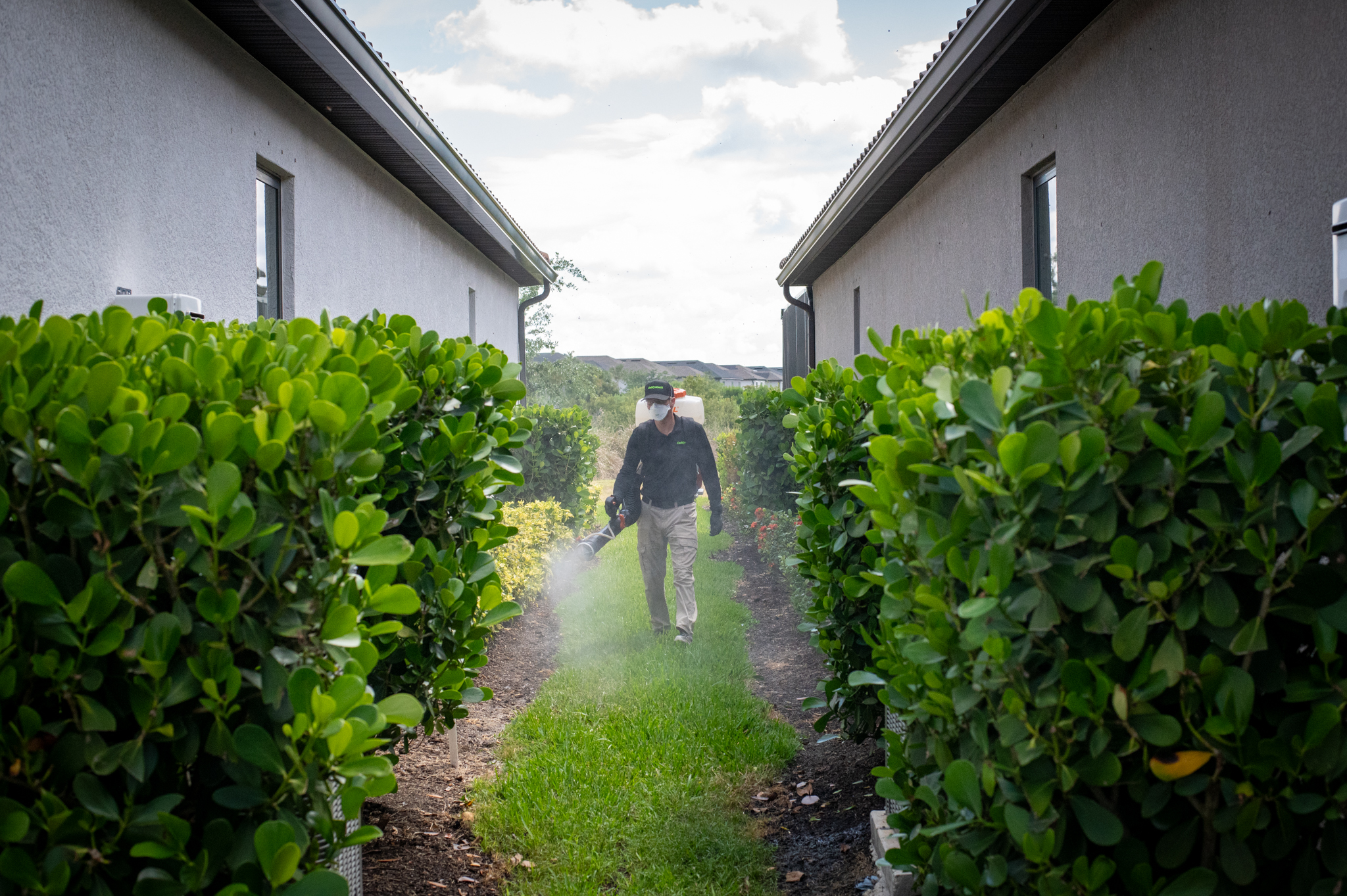
A treatment program targets adult mosquitoes where they rest during the heat of the day - the shaded undersides of foliage, fence lines, dense bed plantings, and the humid spots around foundations and under decks. It also brings a trained eye to breeding-site inspection, which in practice is where most of the value sits. Bromeliads, gutter runs, irrigation boxes, and low spots that hold water after a storm are consistently the sites people miss on their own walkthrough.
It's worth being clear about what this does and doesn't do. A mosquito program reduces the mosquito population and the number of bites on a treated property. It is not a medical intervention and offers no protection against dengue or any other illness. Repellent, screens, and eliminating standing water are what health authorities recommend for reducing your risk of being bitten, and a service should be understood as a complement to those, not a substitute.
If you'd like the inspection-and-treatment side handled on a regular schedule, that's what our Mosquito Shield program covers for homeowners across Hillsborough and Pinellas counties.
Know the symptoms
Most dengue infections are mild or produce no symptoms at all. When symptoms do appear, they typically begin four to ten days after the bite and can include high fever, severe headache, pain behind the eyes, joint and muscle pain, nausea, and a rash.
If you develop these symptoms - especially with a fever - contact your doctor and mention that locally acquired dengue has been reported in the area. A small share of cases progress to severe dengue, which is a medical emergency; warning signs include severe abdominal pain, persistent vomiting, and bleeding from the gums or nose. Seek care immediately if those appear.
For current case counts and county-level guidance, the Florida Department of Health and your county mosquito control agency are the authoritative sources.
The short version
Local dengue transmission in Tampa Bay is a reason to change a few habits, not a reason to panic. Walk your property once a week and dump anything holding water. Use repellent during the day, not just at dusk. Fix your screens. Clean your gutters. Those four things, done consistently, do more against Aedes aegypti than anything else available to a homeowner - and they cost nothing.
If you'd rather not manage it yourself, or you've done all of it and still can't sit outside, get an instant quote or call us at 727-506-2180.
Frequently Asked Questions
Is it safe to be outside in Tampa Bay right now? Yes. A cluster of locally acquired cases means the transmission chain exists locally, not that infection is likely. Standard precautions - daytime repellent, intact screens, and eliminating standing water around your home - substantially reduce your chance of being bitten.
Does mosquito control protect me from dengue? No. A mosquito program reduces the mosquito population and biting pressure on a treated property. It is not a medical treatment and does not prevent disease. Use repellent, keep screens in good repair, and eliminate standing water - those are the measures health authorities recommend for reducing bite risk.
Why does daytime matter? Aedes aegypti, the species that carries dengue, feeds primarily during daylight hours, peaking in the morning and late afternoon. Precautions built around dusk and dawn miss most of its active period.
How small a container really matters? Smaller than most people expect. A flowerpot saucer or a bottle cap holds enough water to produce mosquitoes. Volume matters far less than the water sitting still and undisturbed.
Will my neighbor's yard undo my work? Partly, yes. This mosquito usually stays within a few hundred feet of where it hatched, so nearby breeding sites do affect you. Your own property is still the single biggest factor, and neighborhood-level results are much better when several households on a street address it together.
Can dengue spread from person to person? No. It spreads only through the bite of an infected mosquito. It is not contagious between people.